Custom AI insights
AI Customer Feedback Analysis: Find Useful Patterns Across Reviews, Surveys, and Calls
AI can help small businesses find recurring themes across reviews, surveys, calls, and support records—without turning customer listening into a generic sentiment score.
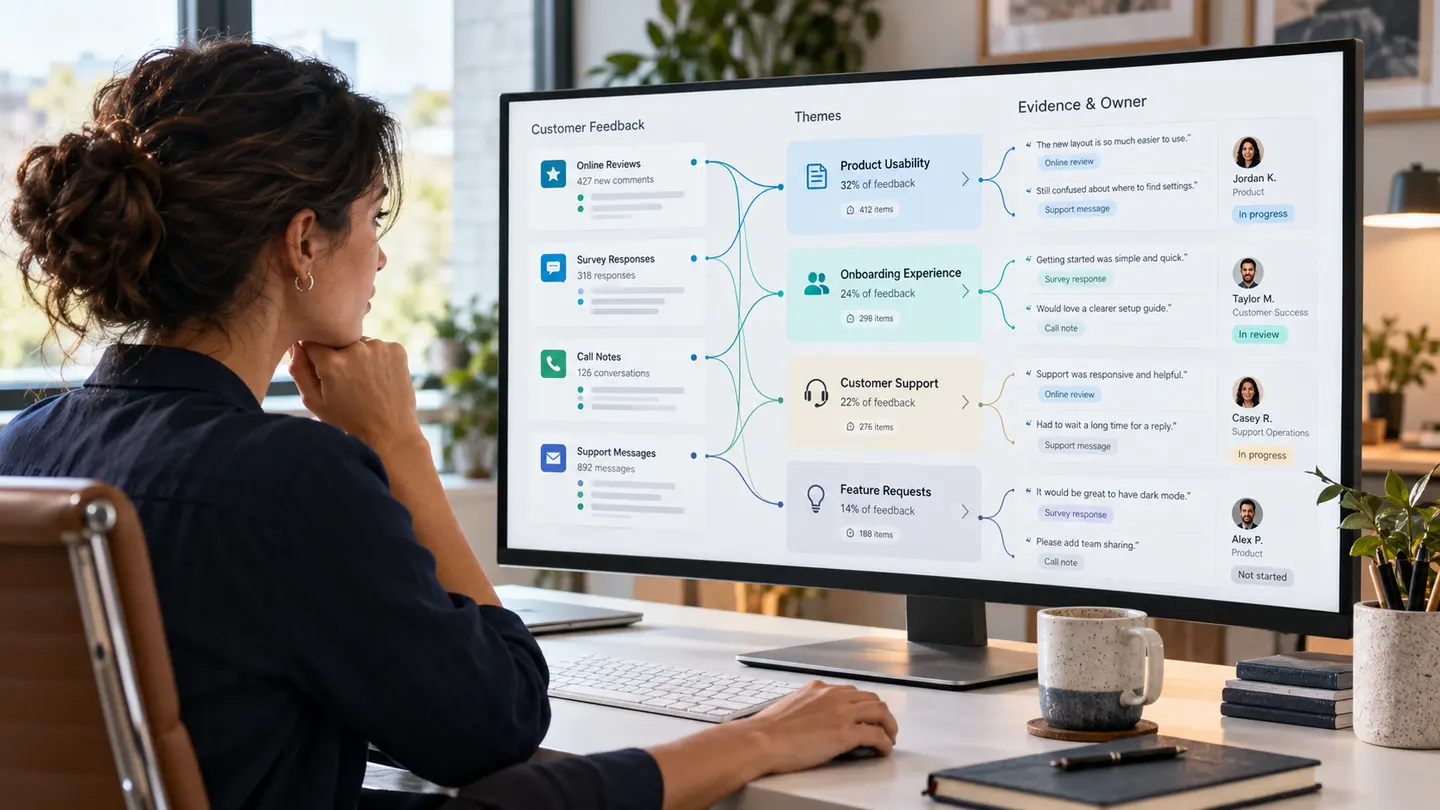
Small businesses receive customer feedback in more places than they realize. It appears in reviews, surveys, support messages, call notes, cancellation reasons, complaint records, follow-up emails, and conversations employees summarize from memory.
The problem is not a lack of opinions. It is that the evidence is scattered, inconsistent, and difficult to compare. One loud complaint can dominate attention while a repeated low-level frustration remains invisible across twenty conversations.
AI customer feedback analysis can help organize that material into themes, preserve examples, and show where a pattern may deserve investigation. It should support listening, not replace it. People still need to decide what the feedback means, which customers were affected, and what the business should change.
Feedback Analysis Is Different From Complaint Triage
Complaint triage helps the business respond to an individual issue quickly and appropriately. Feedback analysis looks across many interactions to find recurring friction, unmet expectations, common praise, confusing language, or changes over time.
Both matter, but they have different owners and timelines. A serious complaint may require immediate human attention. A pattern such as repeated confusion about an estimate may become a process-improvement project. Do not delay an individual response because the system is waiting to classify a trend.
Bring Sources Together Carefully
Start with sources the business is allowed to use and can interpret correctly. Reviews and surveys are usually straightforward. Call transcripts, support conversations, or CRM notes may contain sensitive information and require tighter access, retention, and redaction rules.
Preserve source type and context. A one-star public review, a post-service survey, and a salesperson’s note are not equivalent evidence. The analysis should be able to show where a theme came from rather than flattening every sentence into one anonymous pool.
Use Categories That Match the Business
Generic sentiment labels such as positive, neutral, and negative are rarely enough. Build categories around decisions the business can make: scheduling clarity, response time, estimate accuracy, technician communication, billing, product quality, onboarding, service outcome, or ease of getting help.
Let the system suggest possible themes, but have the team approve the final taxonomy. Allow more than one category when appropriate. A customer may praise the work while criticizing the scheduling process. Forcing one overall label hides the useful detail.
Separate Frequency, Severity, and Business Impact
A common issue is not always the most important issue. Ten comments about a minor inconvenience may be easier to fix than one safety-related report, but the safety issue deserves a different escalation path.
Track frequency, severity, affected customer type, business stage, and potential impact separately. AI can help extract those dimensions from language. Rules and people should determine when something requires immediate escalation, policy review, or direct customer outreach.
Keep the Original Evidence Available
A polished summary can create false confidence. Every major theme should link back to representative comments or source records so someone can verify the wording and context.
Use quotes sparingly and protect personal information. The goal is not to create a wall of anecdotes. It is to make the summary auditable: how many relevant items were found, which sources were included, what period was covered, and what examples support the conclusion.
Let AI Summarize; Let People Interpret
AI can group similar language, identify emerging themes, compare periods, and prepare a concise briefing. It can also be wrong. Sarcasm, industry terminology, ambiguous pronouns, and incomplete notes can lead to weak classification.
A human reviewer should inspect high-impact themes, borderline examples, and any conclusion that could change pricing, policy, staffing, or customer treatment. The system should surface uncertainty instead of turning a rough pattern into a confident claim.
Close the Loop With an Owner and an Action
A feedback dashboard does not improve the customer experience by itself. For each validated theme, assign an owner, decide whether the response is communication, training, process design, product work, or no action, and record the next review point.
Connect the insight to the original workflow. Repeated onboarding confusion may require a clearer welcome message. Estimate complaints may require better exclusions. Slow-response feedback may reveal a routing problem. The value comes from changing the work, not producing more analysis.
Use Customer Information With Restraint
Collect only what the analysis needs. Remove unnecessary identifiers, limit access to raw conversations, and define how long sensitive records are retained. Do not infer protected or deeply personal characteristics simply because a model can speculate from language.
If customer conversations are recorded or transcribed, follow the laws, contracts, and disclosure requirements that apply to the business. A practical system should make its sources and limits clear to the people using the results.
Find the Signal Without Automating the Listening
Customer feedback analysis works best when it helps a small team see patterns that manual review would miss while keeping individual customers, context, and human judgment visible.
Custom AI By Design can help define useful feedback categories, connect approved sources, build a reviewable analysis workflow, and route validated insights to the people responsible for improving the customer experience.
Turn Scattered Feedback Into a Clear Improvement Queue
We can help organize approved feedback sources, define categories that match your business, and build a reviewable workflow that connects recurring themes to responsible owners.
Discuss a Feedback Workflow ↗