Custom AI insights
AI Warranty and Service Claim Intake: Organize Evidence Without Automatically Approving Claims
AI can turn scattered messages, photos, receipts, and service history into a review-ready claim packet while keeping coverage decisions with accountable people.
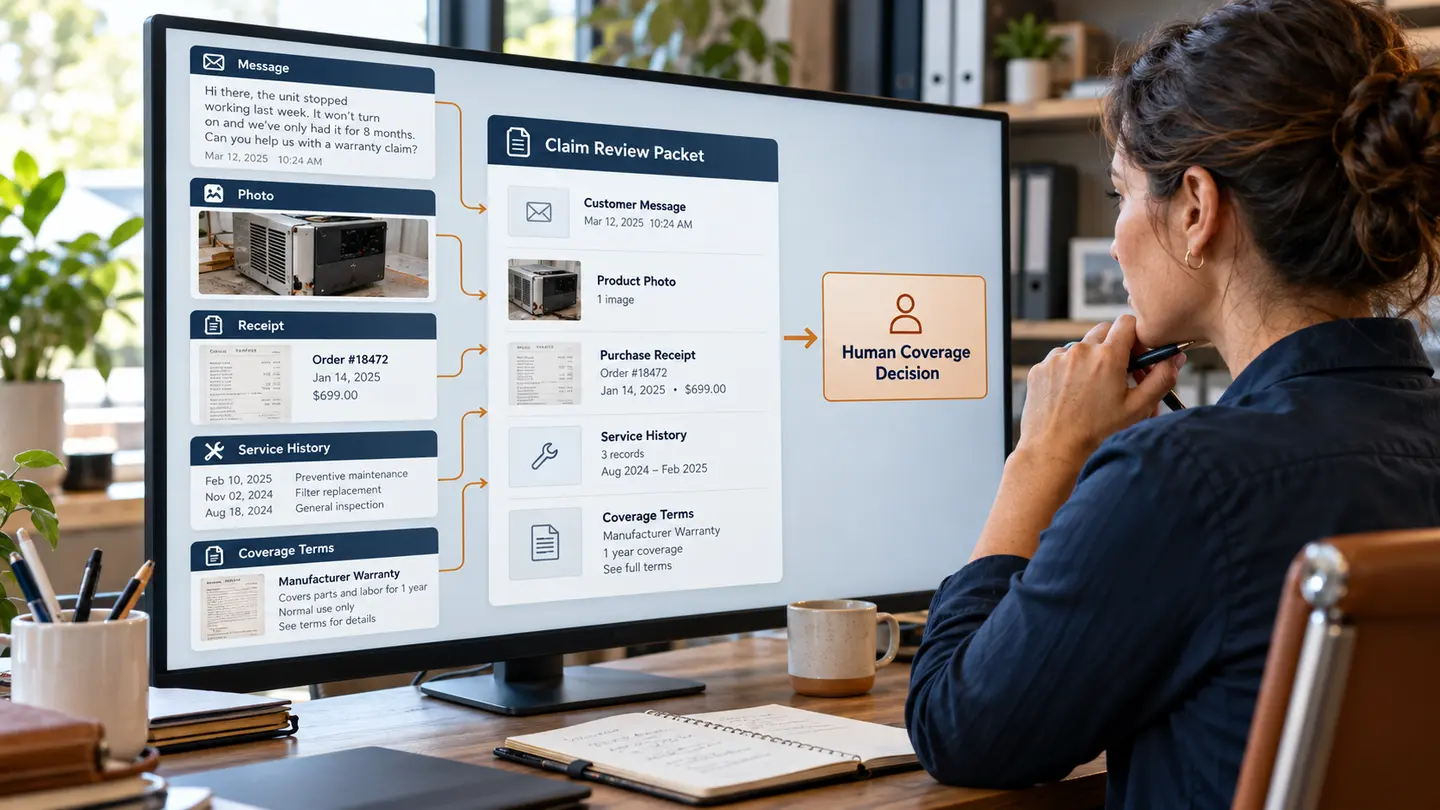
Warranty and service claims rarely arrive as complete, orderly records.
A customer sends a short message, a blurry photo, and an approximate purchase date. The invoice is in one system, the service history is in another, and the coverage terms live in a document that has changed since the product or job was sold.
AI can help collect the missing information, organize the evidence, summarize the history, and route the claim to the right person. It should not quietly decide whether coverage applies, accuse a customer of misuse, or promise a refund or replacement.
The useful system improves intake and review. It does not automate the judgment out of the claim.
Claim Intake Is Different From Claim Approval
Intake gathers the facts needed for review. Approval interprets coverage, evidence, exceptions, customer history, and sometimes legal or financial obligations.
Those stages should remain separate. An AI assistant can ask for the order number, product or service, date, location, issue description, photos, prior service, and preferred contact method. It can check whether required fields are missing and prepare a structured claim packet.
A qualified employee should decide the outcome when coverage or customer commitments are involved.
Collect Information Without Making the Customer Repeat Everything
The assistant should use information the business already has. If the customer enters an order number, the workflow may retrieve the matching purchase, product, installation, or service record. If a prior complaint or repair exists, it can bring that history into the review packet.
Ask only for what is still missing. A customer should not have to retype an address or resend a document the business can already retrieve. Good intake feels organized because the system remembers the case, not because it asks a longer form.
Make Photo and Document Evidence Reviewable
AI can classify uploaded photos, invoices, receipts, forms, and service records, then label which required evidence appears present. It can extract dates, identifiers, and written descriptions to reduce retyping.
That does not make every extracted fact reliable. Preserve the original files, link each summary field to its source when possible, and flag unreadable, conflicting, or incomplete evidence. A reviewer should be able to check the source without hunting through an email chain.
Use the Correct Coverage Terms
Coverage may depend on the product, service date, contract version, region, installer, maintenance history, or type of issue. The system must retrieve the terms that apply to the specific claim rather than using the newest policy by default.
If the records do not clearly identify the applicable terms, the AI should surface the uncertainty. It should never fill the gap with a general explanation that sounds authoritative. Coverage decisions need an accountable owner and, where appropriate, legal or compliance review.
Route Exceptions to the Right Person
A routine claim with complete evidence may go to a standard review queue. Safety concerns, possible property damage, repeat failures, disputed facts, high-value replacements, angry customers, or unclear coverage should receive faster human attention.
Give the system explicit categories and routing rules. Do not ask it to create its own hidden definition of a “bad” customer or suspicious claim. Sensitive labels can affect how people are treated and should be based on documented facts and reviewed policies.
Prepare Responses Without Automating the Decision
Once a reviewer decides, AI can prepare a response using the approved outcome, coverage terms, required next steps, and business tone. The system can also create a shipping task, service appointment, internal work order, or request for additional evidence.
The decision should come from the authorized person or rule system. The message should not promise money, replacement, timing, or fault before those facts are approved. Draft assistance can make communication faster while keeping responsibility visible.
Keep a Complete Case Timeline
Claims become difficult when messages, uploads, internal notes, calls, and decisions are scattered. A case timeline should show what the customer reported, what evidence arrived, which records were checked, who reviewed the claim, what decision was made, and what the business promised next.
AI can summarize the timeline for quick review, but the source events should remain available. This helps the next employee understand the case and gives the business a clearer record if the customer follows up.
Protect Customer Data and Limit Access
Claim records may contain addresses, purchase details, payment information, property photos, serial numbers, and sensitive communications. The intake assistant should access only the folders, fields, and systems needed for the claim workflow.
Use secure upload paths, avoid asking customers to send unnecessary sensitive information, and define retention rules for evidence. Employees should see only the cases their role requires. Convenience does not justify turning every claim file into broadly searchable company data.
Measure Review Quality and Customer Effort
Faster closure is useful, but it is not the only measure. Track how often claims arrive complete, how many times customers are asked for information, time to first acknowledgment, time to human review, rework caused by missing evidence, escalation accuracy, and reopened cases.
Also review whether customers understand the next step. A workflow that closes cases quickly by sending confusing denials is not successful.
Start With One Claim Type
Choose a claim category with repeated intake questions and a clear human owner. Map the required information, sources, coverage references, exception rules, and possible outcomes.
Begin by preparing a review packet without changing any decision process. Once employees trust the packet, add approved follow-up steps such as missing-information requests or internal task creation. Keep coverage decisions and consequential promises under human control.
Want a Cleaner Claim Intake Workflow?
If your team spends too much time collecting the same claim details and reconstructing case history, we can help map an intake and review workflow around your records, coverage rules, and approval process. The system should make the evidence easier to use without making customer decisions on its own.
Turn Scattered Claims Into Review-Ready Cases
We can help map a claim-intake workflow that collects the right evidence, preserves the case history, and keeps coverage decisions with your team.
Describe Your Claim Workflow ↗