Custom AI insights
AI Proof of Concept vs. Pilot vs. Production: What Are You Actually Buying?
An AI proof of concept, pilot, and production system may look similar in a demo, but each stage answers a different business question and requires different controls.
A polished AI demonstration can look like a nearly finished product. It answers a few questions, summarizes a document, or moves information into a sample workflow. The experience may feel convincing enough that a business owner assumes the remaining work is mostly cosmetic.
That assumption creates expensive misunderstandings. A proof of concept, a pilot, and a production system answer different questions. They involve different users, data, controls, failure handling, and responsibilities.
Before paying for a custom AI project, make sure the proposal names the stage being delivered and explains what evidence that stage is supposed to produce.
A Proof of Concept Tests Whether an Idea Is Feasible
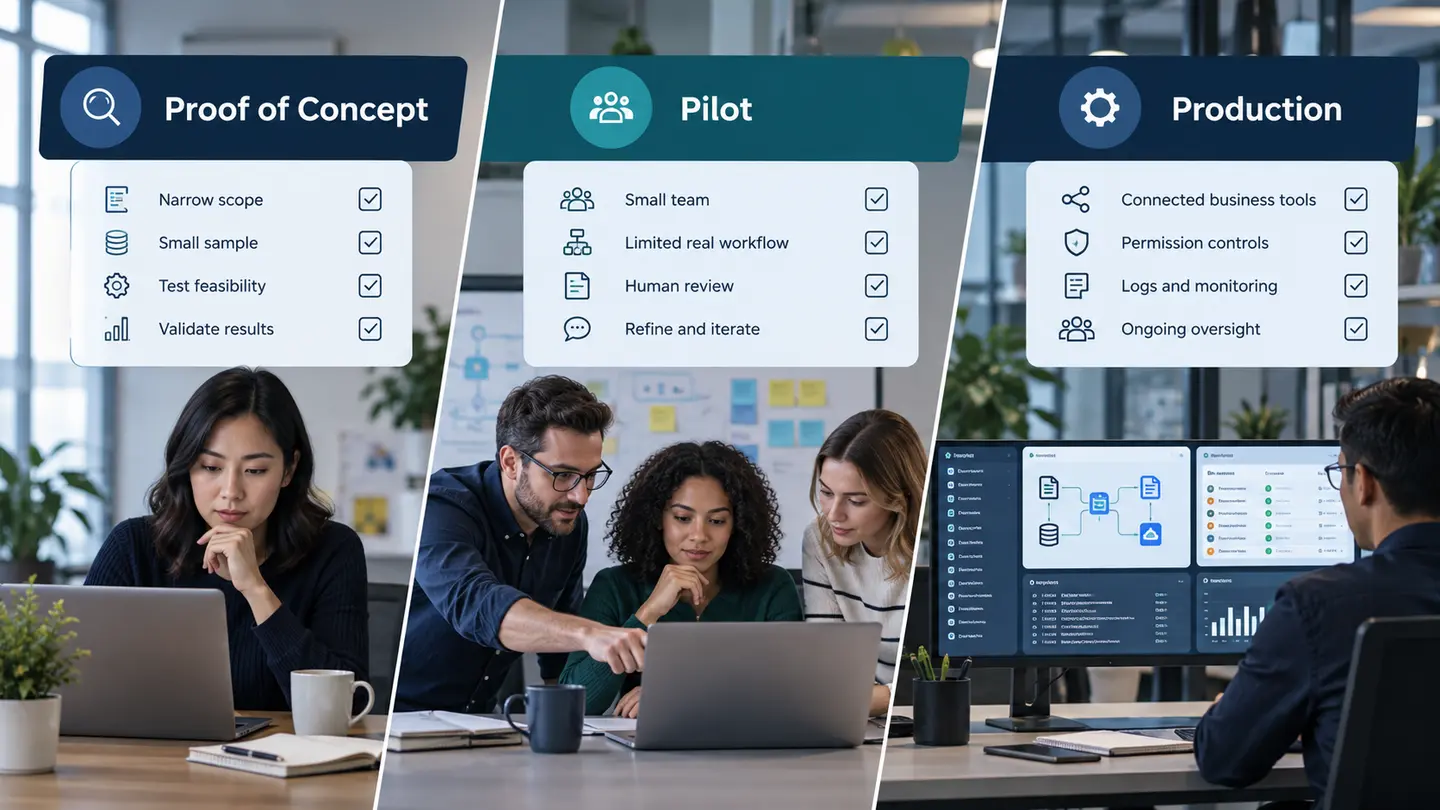
A proof of concept, often shortened to POC, is a limited experiment. Its job is to answer a narrow question such as whether the system can extract the required fields from representative documents, retrieve useful answers from approved sources, or classify a defined set of requests with acceptable accuracy.
A POC may use sample data, manual setup, temporary connections, and a small number of carefully chosen cases. That is not automatically a problem. The mistake is treating the result as proof that the workflow is ready for customers, employees, or live business actions.
A Pilot Tests the Workflow in Real Use
A pilot moves beyond technical feasibility. A limited group uses the system for real work, usually within a narrow scope. The goal is to learn whether the workflow is useful, whether people understand it, whether handoffs work, and where the system fails under normal business conditions.
A strong pilot defines who will use the system, which cases are included, which actions require approval, what information can be accessed, and how issues will be reported. It also establishes success measures such as time saved, error reduction, response speed, adoption, or fewer missed handoffs.
A Production System Has to Keep Working
Production is not simply a pilot opened to more people. A production system needs dependable integrations, permission controls, monitoring, logging, error handling, backups or recovery where appropriate, user guidance, and someone responsible for maintenance.
It also needs clear behavior when a source is unavailable, a request is outside scope, or an action fails. If the system interacts with customers or changes business records, testing must include messy inputs, duplicate requests, access problems, and the possibility that a person assumes something happened when it did not.
The Same Screen Can Hide Very Different Systems
A POC, pilot, and production system can share the same chat box or dashboard. The visible interface does not reveal whether the underlying data is live, whether permissions are enforced, whether actions are logged, or whether a failed connection will be noticed.
Ask what is real behind the demonstration. Is the AI reading current business information or a prepared file? Are integrations live or simulated? Are outputs drafts or actual system actions? Does the workflow support multiple users with different permissions? A smooth demo should lead to better questions, not fewer questions.
Define Deliverables and Acceptance Criteria
A project description should name the stage and its outputs. A POC might deliver a feasibility finding, test results, known limitations, and a recommendation about whether to continue. A pilot might deliver a working limited workflow, user feedback, performance measurements, and a prioritized improvement list.
Production deliverables should address deployment, access, monitoring, documentation, ownership, maintenance, and support. Acceptance criteria should describe observable results rather than vague promises. “Processes approved intake forms and routes uncertain cases for review” is testable. “Uses advanced AI to transform operations” is not.
Use a proof of concept or pilot to prove the need for multi-agent complexity during a limited stage.
Price and Timeline Depend on the Stage
A proof of concept is usually narrower because it is designed to reduce uncertainty. A pilot costs more because it has to work with real users and realistic information. Production work is broader because reliability, security, integrations, support, and change management become part of the system.
That does not mean every project should begin with a separate POC. If the underlying capability is well understood and the main uncertainty is the business workflow, a focused pilot may be the better first step. The stage should match the risk you need to resolve.
Plan the Decision at the End of Each Stage
Every stage should end with a decision. A POC may lead to stop, revise, or pilot. A pilot may lead to stop, narrow the use case, improve the workflow, or prepare for production. Production may expand only after the system proves useful and manageable.
Agree in advance on who makes that decision, what evidence they will review, and what happens to data, access, accounts, and deliverables if the project does not continue. A small experiment is valuable even when the answer is not to build—as long as it answered the right question.
Buy Evidence, Not Theater
The best early AI work does not try to look finished. It makes uncertainty visible and produces evidence the business can use. A clear POC can prevent an unnecessary build. A disciplined pilot can reveal workflow problems before they reach every user. A real production plan shows how the system will be operated after launch.
Custom AI By Design can help define the right project stage, the evidence it should produce, and the boundary between a useful experiment and a system that is genuinely ready for business use.
Know What Stage You Are Paying For
We can help define whether your idea needs a feasibility test, a controlled pilot, or a production plan—and make the deliverables and success criteria clear before work begins.
Discuss Your Project Stage ↗