Custom AI insights
AI Trading Journal: How an Assistant Can Help You Review Your Process
AI can make a trading journal easier to maintain by organizing records, tagging trades, and comparing decisions with the trader's own process.
A trading journal is useful for a simple reason: memory is selective.
After a good trade, it is easy to remember the thesis and forget the rule you almost broke. After a bad trade, it is easy to focus on the outcome and miss whether the process was actually sound.
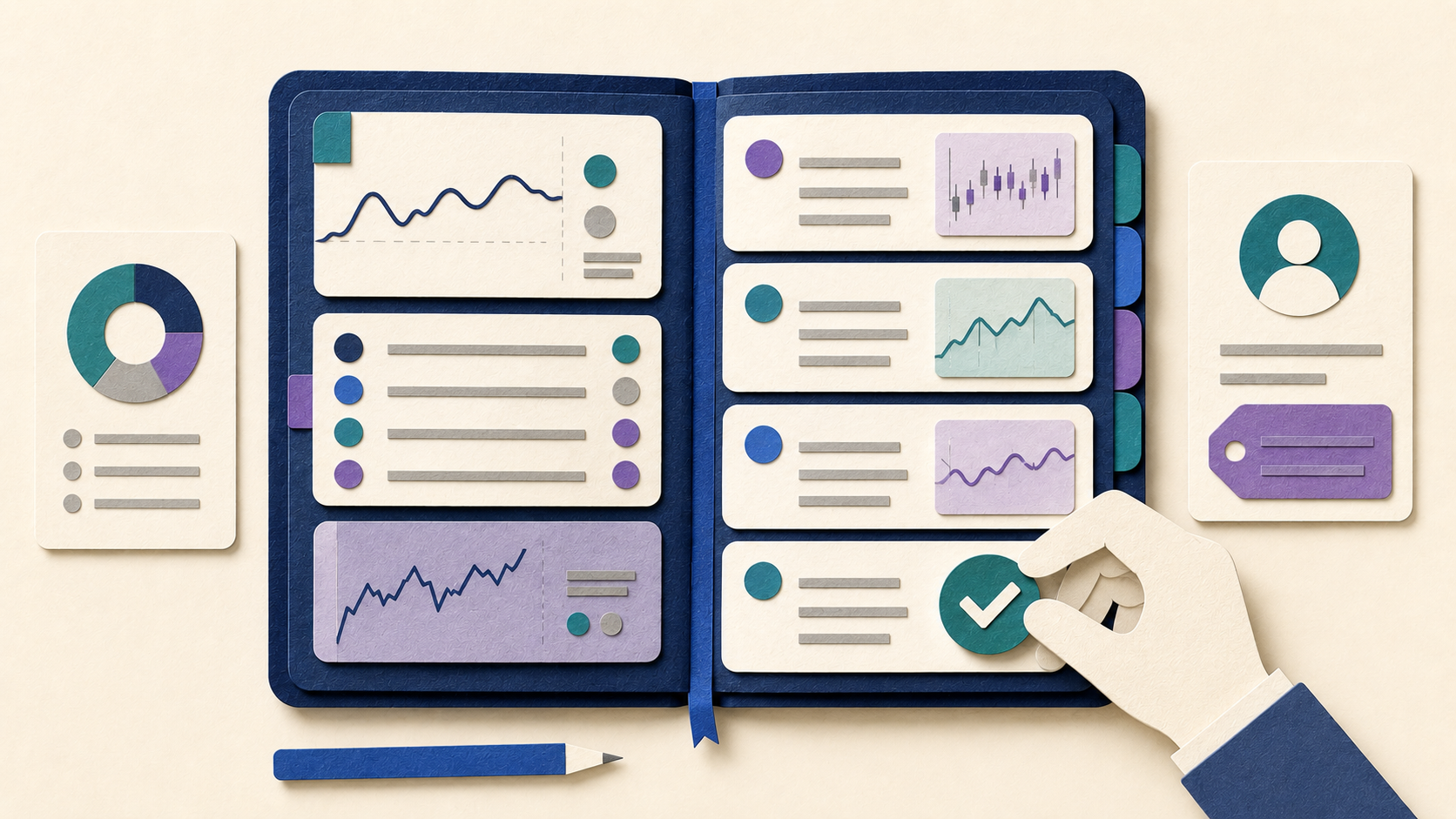
An AI trading assistant can make a journal easier to maintain by organizing notes, tagging trades, comparing decisions with a trader's own rules, and surfacing patterns for review.
It should not decide whether a trade was “good” based only on profit or loss, and it should not turn a journal into an automatic signal generator.
What an AI Trading Journal Can Organize
A useful journal assistant can bring structure to information the trader already records.
That may include the instrument, date and time, setup, thesis, planned entry, actual entry, stop or invalidation level, target, position-size notes, market context, screenshots, emotions, rule exceptions, exit reason, and post-trade observations.
The exact fields depend on the trader's process. The AI should adapt to the journal framework rather than invent a strategy.
Turn Notes Into Consistent Tags
Free-form notes are useful but difficult to review across dozens or hundreds of trades.
AI can classify journal entries using a trader's own categories: setup type, market condition, time of day, rule followed, rule broken, planned exit, discretionary exit, or another custom tag.
Consistent tagging makes later analysis easier, but the categories should be defined and reviewable. The system should not silently change the meaning of a tag over time.
Compare the Trade With Your Own Rules
One of the strongest uses is process comparison.
If the trader has a written checklist or playbook, the assistant can compare the journal entry with those rules and flag questions for review.
For example: Was the required setup present? Was the planned invalidation level documented? Did position size match the trader's stated rule? Was the exit consistent with the plan?
That is different from telling the trader what to buy or sell. It is checking the recorded decision against the trader's own framework.
Separate Outcome From Process
A profitable trade can violate the plan. A losing trade can follow it.
A useful journal should help keep those ideas separate.
AI can summarize process adherence independently from P&L and highlight cases where a positive result may have rewarded a rule violation or where a negative result came from a trade that followed the intended process.
That can make review more disciplined, but the trader remains responsible for interpreting the pattern.
Look for Patterns, Not Predictions
Once journal entries are structured, an assistant can help surface descriptive patterns.
It might show that a particular setup appears most often at a certain time, that rule violations cluster after several trades in one session, or that certain exit notes repeatedly mention the same problem.
Those observations can be useful prompts for deeper analysis.
They are not proof that the pattern will continue and should not be presented as a prediction of future returns.
Use Screenshots and Context Carefully
A trading journal often includes chart screenshots, news notes, market regime observations, and other context.
An assistant may help label or summarize those materials, but visual interpretation should be treated as context rather than certainty.
If the journal pulls in external market data, timestamps and sources matter. A review should distinguish information that was available at the time of the trade from information learned afterward.
Protect the Integrity of the Journal
A journal becomes less useful if the AI rewrites history.
Preserve the trader's original notes and timestamps. AI summaries, tags, or observations should be additive and identifiable rather than silently replacing what was recorded.
That keeps the journal auditable and reduces hindsight bias.
What an AI Trading Journal Should Not Do
A journal assistant should not promise profitability, declare that a pattern guarantees an edge, or convert descriptive observations into personalized buy or sell instructions.
It also should not hide uncertainty behind polished language.
Its job is organization, comparison, retrieval, and review support. The trader makes the trading decisions.
Start With the Journal You Already Use
You do not need a complicated platform to begin.
A custom assistant can often work around an existing spreadsheet, database, notes system, screenshots, or exported trade history.
Start by defining the fields, tags, rules, and review questions that matter to you. Then use AI to reduce the manual organization required to keep the journal current.
Educational Trading Disclaimer
This article is for educational and informational purposes only. It is not investment advice, financial advice, or a recommendation to buy or sell any security or financial instrument. Trading involves risk, including the risk of loss. A trading assistant should support research and process review, not replace the trader's judgment or responsibility.
Want a Trading Journal Built Around Your Process?
If you already have a trading checklist, journal, or review routine, a custom AI assistant can help organize it without forcing you into someone else's strategy.
Custom AI By Design can help connect your rules, notes, screenshots, and trade records into a review workflow that keeps the trader in control.
Want a trading journal that fits your actual process?
Tell us how you record trades, what rules you review, and which tools you already use. We can help design a custom journal assistant around your workflow.
Discuss Your Trading Assistant ↗