Custom AI insights
AI Trading Assistant vs. Trading Bot: What’s the Difference?
An AI trading assistant supports research and decisions while a trading bot can execute automatically. That one difference changes the entire risk profile.
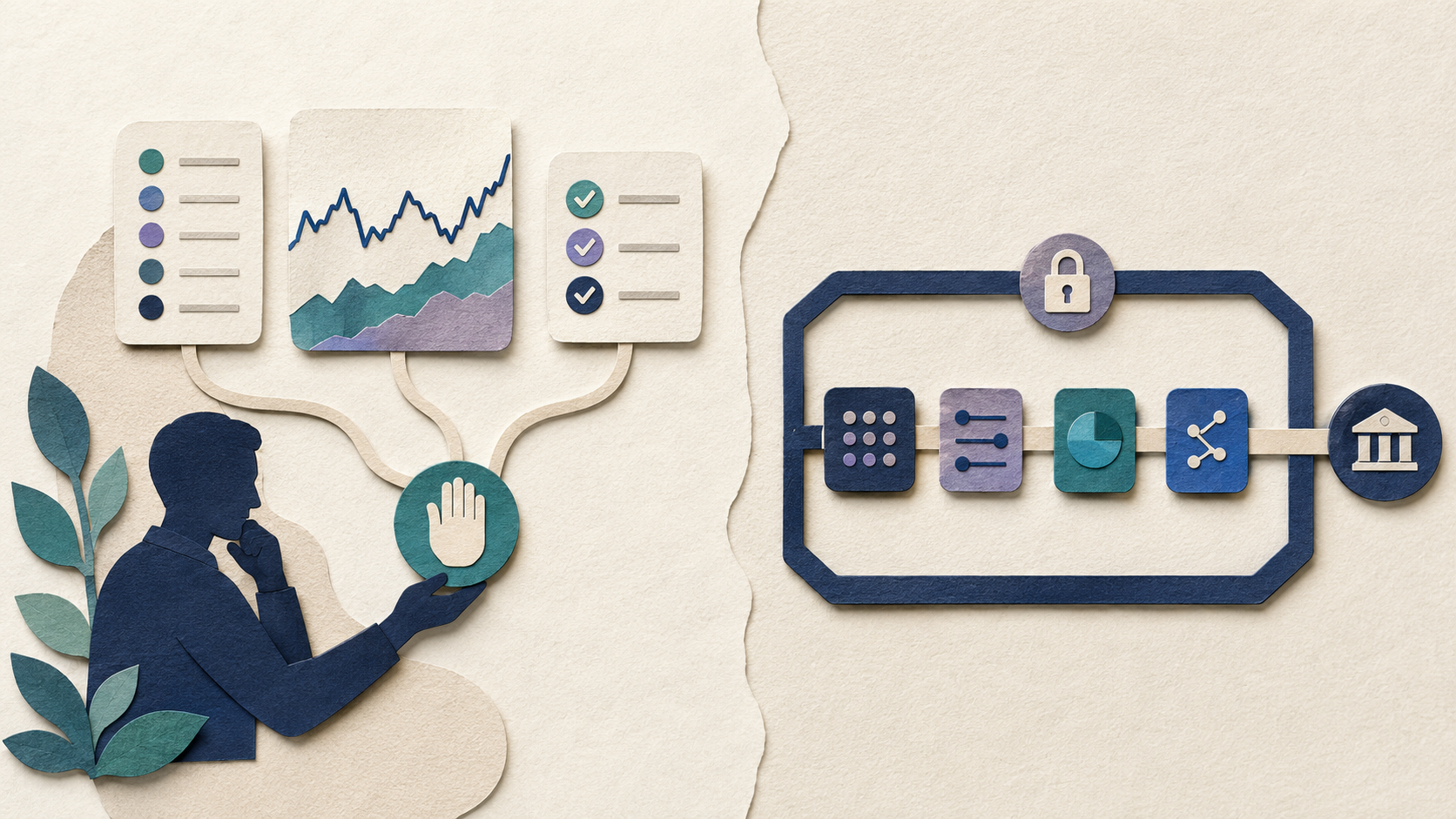
The terms AI trading assistant and trading bot are often used as if they mean the same thing.
They do not.
An AI trading assistant is primarily a decision-support tool. It can organize market information, explain what it sees, help a trader review a setup, track rules, summarize news, or prepare research. The trader still decides what to do.
A trading bot is built to execute trades automatically according to programmed logic or another automated decision process.
That difference changes the risk, the required controls, and the role the human plays.
What Is an AI Trading Assistant?
An AI trading assistant helps a trader process information and follow a workflow.
It might review a watchlist, summarize relevant news, explain a chart or indicator, compare a setup with the trader’s written rules, organize notes, generate a pre-trade checklist, or summarize what happened after the session.
It can also surface questions a trader may want to consider before acting.
The defining point is that the assistant supports the decision rather than silently making and executing it.
What Is a Trading Bot?
A trading bot places orders automatically based on rules or signals.
Traditional bots may follow fully deterministic logic such as price levels, indicators, or timing rules. More advanced systems may incorporate models or adaptive components.
Once execution is automated, the system needs reliable broker connectivity, order-state handling, risk limits, monitoring, and a way to stop safely when something goes wrong.
That is a very different operational responsibility from an assistant that stops before the order.
The Biggest Difference Is Who Pulls the Trigger
With an assistant, the trader remains the decision-maker.
With a bot, the software may enter, modify, or exit positions without a separate approval for every action.
That does not make one category automatically good and the other bad. It means they solve different problems.
A discretionary trader may value faster research and better discipline. A systematic strategy may benefit from automation when the rules are stable, testable, and monitored.
Where a Trading Assistant Can Help
A well-designed assistant can reduce information overload.
It can collect data from approved sources, summarize filings or news, compare current conditions with a checklist, track a journal, identify whether a planned rule was followed, and produce alerts when defined conditions deserve attention.
It can also maintain context about the trader’s own process instead of giving the same generic answer to everyone.
None of that guarantees a profitable decision. It is organization and analysis support.
Where Automated Trading Adds More Risk
Automatic execution creates risks that do not exist when a human approves every trade.
A strategy can behave badly when market conditions change. Data can be delayed or wrong. An API can fail. Orders can be rejected or partially filled. A bug can repeat an action. A rule that looked good in testing can perform poorly in live markets.
Automation therefore needs hard limits, monitoring, logs, and clear failure behavior.
AI confidence should never be treated as a substitute for risk controls.
Be Careful With Broker Access
An assistant does not always need trading permissions.
If the job is research, chart review, journaling, alerts, or scenario analysis, read-only data may be enough. In some cases, the assistant may not need a broker connection at all.
Granting order permissions should be a separate decision with a clear reason.
The safest architecture gives every component only the authority required for its actual job.
Custom Assistant vs. Generic Chat Tool
A general AI model can discuss markets, but it does not automatically know your watchlist, rules, journal, preferred data sources, risk framework, or workflow.
A custom assistant can be designed around those inputs and can keep the interaction consistent with the way the trader works.
That does not make the AI an investment adviser or a source of guaranteed signals.
It makes the software more relevant to the user’s process.
Questions to Ask Before You Use Either One
Ask what data the system uses, whether the information is real-time or delayed, whether it can place trades, what permissions it requires, what gets logged, how errors are handled, and how the user can verify the underlying information.
For automated execution, also ask about position limits, order limits, kill switches, duplicate-order protection, API failures, and what happens when the system loses connectivity.
Those questions matter more than whether the product calls itself intelligent.
Keep the Human Responsible for the Decision
AI can help a trader process more information and follow a more consistent routine. It can also be wrong, incomplete, outdated, or overconfident.
Use it as a tool, not as a promise.
This article is for educational purposes only and is not financial, investment, or trading advice. Trading involves risk, including the risk of loss.
Interested in a Custom Trading Assistant?
If you want an AI tool built around research, alerts, journaling, or your own trading workflow, start by deciding what the assistant should know, what it may do, and where it must stop.
Custom AI By Design can help design a trading assistant around those boundaries while keeping the trader in control.
Want a trading assistant built around your process?
Tell us how you research, review setups, track rules, and record trades. We can help design an assistant that supports those steps without pretending to remove market risk.
Explore a Trading Assistant ↗