Custom AI insights
AI Agent vs. Chatbot vs. Automation: What Does a Small Business Actually Need?
Chatbots, AI agents, and automations solve different problems. Here is how to choose the simplest combination that fits the job.
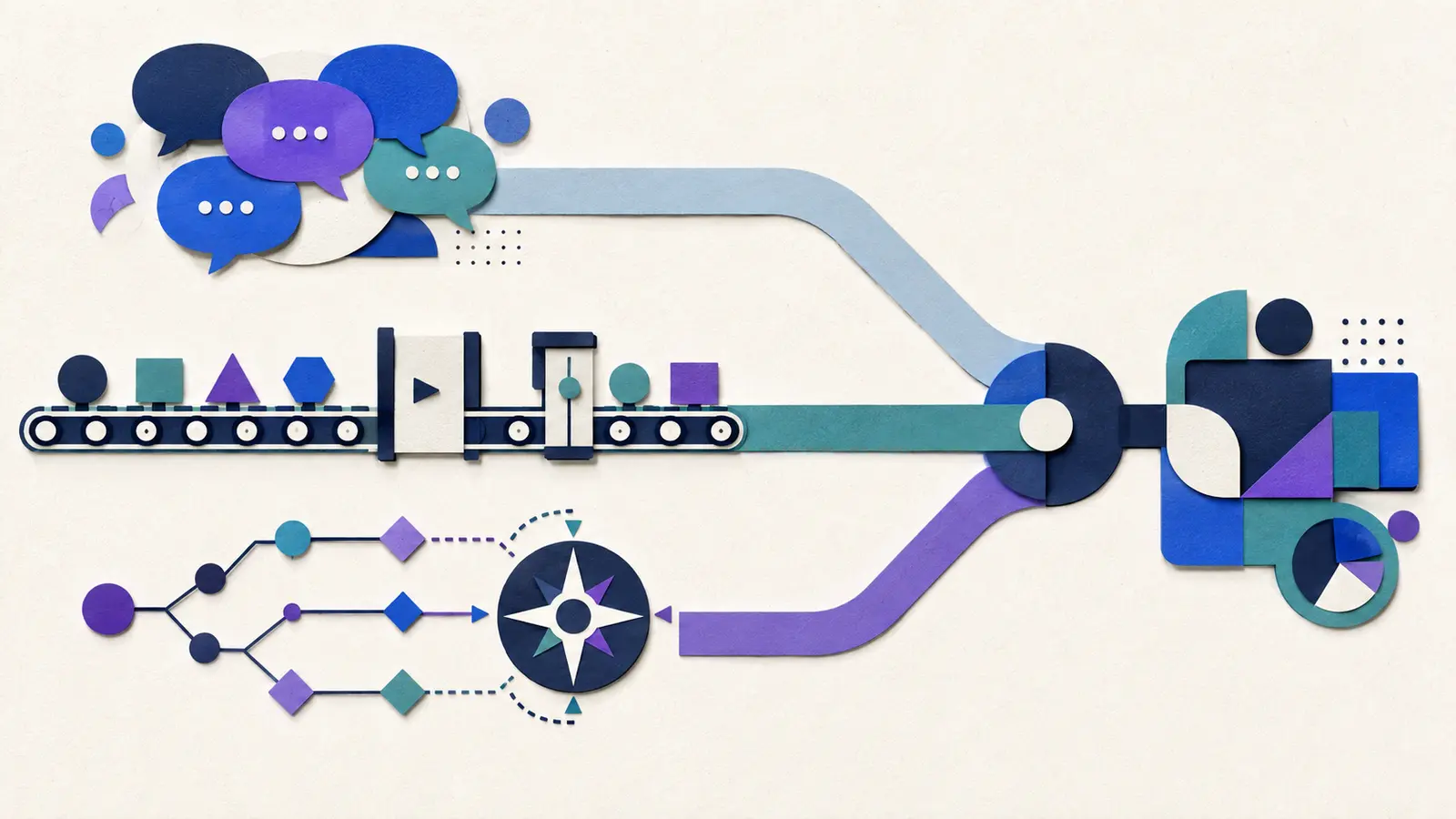
AI terminology has become a small business problem of its own.
Chatbots. AI agents. Automations. Assistants. Workflows. Copilots.
Different vendors use the same words to describe different things, which makes it hard to know what you are actually buying.
The good news is that you do not need to memorize the vocabulary.
You need to understand the job.
A chatbot, an AI agent, and a traditional automation can all be useful. They simply solve different kinds of problems.
What Is a Chatbot?
A chatbot is primarily a conversation interface.
It lets a customer or employee ask questions and receive responses.
A simple chatbot may follow scripted paths. An AI chatbot can interpret natural language and answer from approved business information.
For a small business, chatbots are useful when the main problem is communication: repeated website questions, service guidance, basic lead intake, internal FAQs, or after-hours first response.
The conversation itself is the center of the experience.
What Is Traditional Automation?
Traditional automation is built around rules.
When X happens, do Y.
A form submission creates a CRM record. An invoice is paid and a receipt is sent. A new lead triggers a notification. A status change moves a task to another queue.
This kind of automation is powerful because it is predictable.
When the input and rules are structured, traditional automation is often better than AI. You do not need an intelligent model to copy a known value from one field to another.
Use the simplest technology that can reliably do the job.
What Is an AI Agent?
An AI agent usually combines language understanding with the ability to take actions toward a goal.
Instead of only answering a question, it may determine which steps are needed, use connected tools, retrieve information, create or update records, and decide what action to take next within defined boundaries.
For example, an agent might receive a customer inquiry, determine the type of request, gather missing details, check approved information, create a summary, and route the case.
That is more capable than a basic chatbot, but capability also creates more complexity and more places where boundaries matter.
The Most Useful Systems Often Combine All Three
The categories are not mutually exclusive.
A customer may interact with a chatbot.
Behind that conversation, an AI system may interpret the request.
Then traditional automation may create a record, notify a staff member, or move data between tools.
In other words, the visible chatbot may be only the front door.
A strong business system often uses AI where interpretation is needed and ordinary automation where the next step is deterministic.
When a Chatbot Is Enough
Choose a chatbot-first approach when people mainly need answers, guidance, or conversational intake.
Examples include answering FAQs, explaining services, collecting lead details, helping customers prepare for an appointment, or letting employees search internal information.
If the system does not need to take many actions in other tools, a focused assistant may be all you need.
When Traditional Automation Is Better
Use traditional automation when the workflow is structured and predictable.
If every approved quote should trigger the same email, if every completed form should create the same record, or if every status change should notify the same person, AI may add unnecessary uncertainty.
Rules are a feature when the rule is known.
Do not use AI merely to make a simple workflow sound more advanced.
When an AI Agent Makes Sense
An agent becomes more useful when the system needs to interpret messy input, decide which path applies, use several sources, or complete a multi-step task.
That might include triaging inbound requests, preparing customer records from unstructured messages, coordinating several tools, or handling a workflow where the exact next step depends on context.
The more autonomy you add, the more important testing, permissions, monitoring, and human escalation become.
How to Choose the Right Approach
Start with four questions.
What is the user trying to accomplish? What information does the system need? Which parts require interpretation? Which parts follow fixed rules?
Then separate the workflow.
Use conversation where conversation helps. Use AI where interpretation helps. Use deterministic automation where the rule is already clear. Keep humans where judgment, responsibility, or relationship matters.
That architecture is usually more reliable than asking one technology to do everything.
Do Not Pay for a Label
A vendor can call a product an “AI agent” without that label telling you whether it will solve your problem.
Ask what the system actually does.
What information can it use? What actions can it take? Which tools can it connect to? What happens when it is uncertain? What can a human review? How are errors handled?
The answers matter more than the category name.
Need Help Choosing the Simplest System That Works?
If you know the workflow you want to improve but are not sure whether you need a chatbot, an agent, traditional automation, or a combination, we can help you map the job first.
The best solution is not the one with the fanciest label. It is the one that solves the problem with the least unnecessary complexity.
Ready to find the right AI use case?
We can help you map the workflow, choose a practical starting point, and design a custom system around the way your business actually works.
Start a Conversation ↗Explore Custom AI